Contact ME

Use the form on the right to contact me. Better yet, contact me here and receive a free gift. Looking forward to connecting with you! 

Thanks, 
Hannah Green MFT

1195 Valencia St
San Francisco, CA, 94110
United States

415-238-1915

Holistic psychotherapy in San Francisco for individuals and couples.

families.jpg

Blog


Embracing the Shadow

Hannah Green

Dear Community,

What does it mean to be whole? How do we create balance in our lives and heal addiction? Where does a sense of aliveness, wonder and purpose come from? What creates real and lasting intimacy? How do we come to peace with our past? What does it mean to grow up and individuate? How do I live from a place of authenticity, power, vulnerability, love and creativity? 

These are the themes I sit with and explore every day - in my own life in in my work with individuals and couples. Shadow work allows people to explore these questions in highly personal, insightful and transformational ways.

The shadow is what is unknown, undeveloped or unsupported in us. It is the rich soil of our potential. The process of exploring and owning our shadow can be exciting, mysterious, empowering, vulnerable and enlivening. The shadow is everywhere in Nature and in her cycles. Perhaps Nature can inspire us to embrace our shadow ~ opening us to the cycles of life and the feelings that flow through us.

Join me for a fun evening of exploration, active imagination and ritual exploring the shadow. I hope to see you there! Register here

Marianne Woodman on the Shadow

Some great books and resources on the Shadow

Owning Your Shadow: Understanding the Dark Side of the Psyche
By Robert Johnson

Meeting the Shadow: The hidden Power of the Dark Side of Human Nature
By Connie Zweig

The Dark Side of the Light Chasers: Reclaiming Your Power, Creativity, Brilliance, and Dreams
By Debbie Ford

Wonderful talk by Marianne Woodman on the Shadow

Jungian Psychology and Working With the Tarot

Hannah Green

Dear Community,

Images are powerful. Through art and image we connect to our native language of symbolism. Images transform us because they externalize our internal world and so facilitate new insight, awareness and relationship with Self.

I work with images a lot. When new clients comes to see me I often have them look through some images and choose a few that speak to them about where they are now and where they are going. I always find this to be profound. The images invariably express volumes and are often the most efficient path to deep clarity and understanding. We see the images, feel the feelings they evoke and hear the truth bell ring inside.

I draw these images from the hundreds I have collected and been given over the years. These images initiated me into the language of symbol. I developed this language as a way of seeing and connecting with my client's experience. The images give my clients a tool for connecting with themselves and facilitate an interpersonal connection between us. They bring the archetypes into the room. They ferry us to the inner world. I see my job as therapist as simply supporting my client in accessing their inner world. This access is the healing agent. 

Gradually I realized these images were my own personal Tarot deck that my psyche had gathered, attracted and collaged over the years. My therapist loves Tarot and has gradually introduced the cards into our work over the years. My dear husband is Tarot gifted and gave me an old deck of his a few years ago. These key influences and my love of art, images, archetypes, mythology and Jungian Psychology naturally evolved into a love affair with Tarot. The last few years I have been studying and practicing the Tarot and I feel I have reconnected with a vital resource. The cards are in essence a map of the soul, a map of the human experience and much, much more. 

As a therapist I feel empowered and inspired by the cards to: 

  • Connect with feelings. Simply being with feelings is the real work in therapy. Tarot images anchor us in feelings. They invite us to feel with the figure depicted, with their visual material, their colors and their depictions of the four elements: fire, water, air and earth. We are made up of these elements and awareness of them can help us to stay present with what we feel in our bodies. Despite my training and education I still find simply being with feelings instead of fixing or intellectualizing incredibly challenging. Learning to be with feelings is perhaps my biggest growth opportunity as a therapist. The Tarot imagery helps us connect to the feelings.


  • Talk about the process of individuation. Sometimes its hard to see the big picture. When we are "in it" its hard to see that we are on a path of growth and awakening - a path Jung called Individuation. My job as therapist is to share that birds eye view and to help my client reflect on her journey as a whole. This helps my client see how far she has come and to connect with where she is going. The cards speak to the soul's journey and outline the spiritual challenges and opportunities we face along the way. The cards help my client and I sit back and look at the bigger picture and acknowledge her journey of individuation.


  • Identify, hear and integrate different parts of Self. As a Gestalt trained therapist I think in terms of 'parts of Self' I have learned that people have many dimensions and personalities and that this is not pathological. What can cause difficulty is when parts of Self are denied, unconscious, unsupported or unintegrated. When we insist on being a one dimensional character with one set of unified opinions and desires, we deny our richness and wholeness. It takes energy to tolerate and sort out these internal and external conflicts but it is necessary if we are to grow. The cards acknowledge all of us and give our parts permission to be. The characters in the cards depict parts of our humanity. The Tarot imagery can help us identify, acknowledge, listen to, accept and integrate different parts of Self.

  • Externalize the internal experience - as with all art therapy, working with Tarot imagery we move whats happening inside to the outside. This can help us move when we feel stuck. It can calm our nervous system and help us take a step back. Externalizing the internal allows for dialogue which opens us up to new perspectives and self awareness. It creates the potential to be heard and understood by another and by ourselves and so enables empathy and compassion. The process of externalizing ultimately helps connect us withe observer, wise mind or soul part of us, the benefits of which are too many to list.

There are many ways to access the inner world, connect with feelings and look at the big picture. The Tarot is one way. Find and enjoy the ways that work for you. 

Here are some of my favorite books about Tarot to spark your interest: 

Jung and Tarot: An Archetypal Journey
By Sallie Nichols

The Way of the Tarot: The Spiritual Teacher in the Cards
By Alejandro Jodorowsky and Marianne Costa

Wanderer's Tarot Guidebook
by Casey Zabala

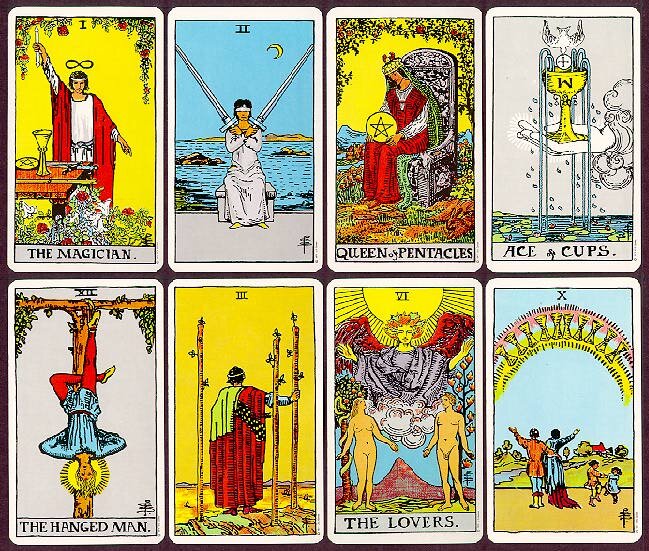
The images above are from the Rider Waite deck however there is a vast treasure trove of interpretations of the Tarot. You can find a deck that speaks to you. 

Jessica Dore also has an introductory class and I highly recommend her. Following her in social media will also expose you to the cards and her interpretations of them which are grounded in her mental health background. 

I hope you are having a lovely Summer. I am facilitating a workshop in September called Embracing the Shadow. I would love to see you there at The Scarlet Sage as we head into Autumn and the Earth's Shadow time. See the link below for details.

Enjoy!

july email 2019.jpeg

Physical Boundaries and Safety

Hannah Green

Dear Community,

Happy June! Above is the Goddess Kali, destroyer of evil forces, the divine protector, divine mother and bringer of liberation. She is the most powerful form of Shakti or divine feminine. She burns with divine light as her consort Shiva lies calm and prostrate beneath her. 

This month I want to talk about channeling our own inner Kali and committing to personal safety. I was given the suggestion by one of my mentors to take Impact Bay Area's three day self defense course for women. Despite a lot of initial resistance - this month I did it!. I am really proud of myself for completing the course and managing the physical and emotional labor involved. I want to share about my experience to potentially inspire others to take this course or to commit to personal safety in a way that is right for them. 

For me the experience was so powerful and had physical, emotional, mental and spiritual components. 

  • Physical: I learned specific techniques for responding effectively to real life attack scenarios. I got to feel the power of my full force hits and kicks (turns out my kicks are deadly). I got to move through my learned freeze response. I learned to channel my voice to add strength to my verbal boundaries and physical strikes. I got to train my nervous system to respond, fight back and to deescalate and call help.

  • Emotional: I got to process emotions - including anger, rage, shame and sadness and to release emotions from past traumas. I was able to let go of carried shame which is the shame victims take on from their abusers. I felt immense gratitude for my physical body and love and empathy for the incredible women also participating in the course.

  • Mental: I was able to understand more of my internalized sexism and identify victim blaming more clearly. As a result I was able to let go of limiting beliefs around who I am or need to be to be safe or accepted by others. It is ok to be powerful! It is ok to be fierce! My understanding of functional boundaries was enhanced and effective self defense language was clearly defined.

  • Spiritual: I experienced the power of the Sacred Feminine flowing through me and through the women in the group. I experienced a new level of personal worth and value and was able to commit more deeply to my personal safety and well being. I am worth fighting for.


How committed are you to your personal safety and the safety of other women? How ready are you to stop victim blaming once and for all? How do you recognize the freeze response and move through it? What do you want to say "NO" to? What techniques will help you avoid a physical fight or effectively defend yourself if necessary? How do you set verbal boundaries with strangers and acquaintances? How do you use your voice to empower yourself and other women? How has misogynist culture affected you, your voice and your nervous system? How do you channel your strength to protect yourself fiercely?

The supportive and skilled instructors at Impact Bay Area can hold space for these explorations. 

I won't say this three day workshop is "years of therapy" but in a way it is. The effects of working physically and in arousal states are deep. I learned skills that are now committed to muscle memory. Learn more about the women's basics course below. The Women's Basics Course is for all who identify as female. Impact also has an LGBTQ BASICS COURSE.

WOMENS BASICS COURSE

We just returned from Indian Springs - one of my favorite places to connect to the elements and experience the healing balm of water and nature. I am reminded of how vulnerable it actually is to relax. No wonder as women we are so prone to stress and over doing - to relax is to be vulnerable and the world is not always a safe place for women. I am committed to changing that - starting with myself. Sending deep love and respect to every woman and the Kali energy within. 

june email 2019.jpeg

Myth of Psyche

Hannah Green

Dear Community,

I hope you had a wonderful May. We have crossed the threshold into Summer and I wish you a a lovely season filled with fresh berries and sojourns into nature!

The Greek myths are a treasure trove of insight into human nature and psychology. Myths use story and symbol to show us our fears, desires, greatest strengths and challenges. The myth of Psyche is a powerful archetypal story that I connect with deeply. Psyche has two meanings in Greek: Soul and butterfly. The myth of Psyche describes the journey of the soul, of transition, of transformation and individuation. Psyche (Soul) and her lover Eros (Love) are separated through a series of events involving the Goddess Aphrodite. In order to be reunited Psyche must complete 4 tasks to appease the Goddess. There are many important and fascinating aspects to Psyche's journey. This month I am focussed on Psyche's third and fourth task which illustrate the theme of this email: boundaries and emotional detachment. As we will see in Psyche's journey, learning emotional detachment and how to say NO is necessary and challenging ~ even for Gods and mythological beings! 

Listen to the tasks she completes metaphorically and see how they articulate navigating a transition/ transformation. See how they also outline the therapy/recovery process. Aphrodite tasks Psyche to:

  1. Sort a mountain of seeds. Metaphorically this represents the inventory process and stock taking we need to do at the beginning of a transition. What is happening? What is serving me and what isn't? What parts of me are in the forefront and what parts are underground? What is going on in my relationships? Initially Psyche is discouraged and resistant and when she finally surrenders to the task she notices an army of ants assisting her and instinctually sorting and organizing the seeds.

  2. Gather some golden fleece from the the competitive, head butting Rams of the sun. Here Psyche takes advice offered by a river reed and instead of battling with the Rams, waits until nightfall to gather the fleece collected in the brush. Psyche learns find her own rhythm, to listen to nature (the reed) and to the cycles of nature (night and day) so as not to trample her soul in pursuit of a goal.

  3. Fill a crystal flask with the water of life flowing continuously from the river Styx. She must ascend to the highest crag guarded by snake-like dragons to reach the fountain. Symbolically she captures the creative ever flowing life force and shapes it to her own personality and form. Jean Shinoda Bolen writes that the creative task of capturing the water in the crystal is akin to "a conscious desire to capture archetypal energies, visions, emotions and give them shape through your own personality." This task is the creative act. Psyche is helped by Zeus' Eagle who shows her that in order to succeed she must be focussed, emotionally detached, determined and have crystal clear vision.

  4. Travel to the underworld, fill an empty box with Persephone's beauty ointment and bring it to Aphrodite. Dismayed, Psyche believes the only way to visit the underworld is to die and so she climbs to the top of a tower to leap to her death. The tower speaks to her and tells her of a secret passage to the underworld and instructs her to take cakes and for the three headed guard dog and coins for the ferryman. The tower admonishes her that she will be asked for help three times and three times she must refuse. The tower tells her, "Three times you will be asked for help, Psyche. You must harden your heart to pity, refuse, and go on." Psyche does indeed say no three times and successfully crosses the river Styx and emerges from the underworld with her prize.

Psyche's initial reaction to each of the the tasks is despair. She succeeds by surrendering to her task and is helped by instinctual nature, the divine feminine (embodied by nature and the river reed) and divine masculine (embodied by Zeus' Eagle). The fourth task requires she help herself.

Is saying no and practicing emotional detachment so hard that even mythological beings are grappling with it? Many of us would say yes.

Perhaps we were not told/shown in childhood: It is Ok to be more well than the people around you. It is OK to say no. It is OK if people don't like you. It is OK to disappoint people. It is OK to stand out and be different. It is OK to be successful. It is OK to protect yourself and your energy. In fact many aspects of families and society give us another message: In order to be loved you must in one way or another give up your boundaries.

Growing up we make certain pacts unconsciously. Our physical, emotional and psychological survival was based on learning what we needed to do and who we needed to be in order to get safety, inclusion and love. These pacts became the basis for our our personality and characterized the first half of our lives. We found out what played well for the family system, brought those aspects to the foreground and sent the rest underground.

The second half of life is about excavating these underground aspects of self. During the excavation we descend and bring forth those parts of ourselves that once threatened survival because ironically our survival may now depend on them. This excavation is necessitated and facilitated by life transitions like Psyche's journey. The journey may show up as love lost, addiction, depression or illness. These often vilified phenomenon are actually the catalysts for the live affirming journey of individuation.

Like Psyche, during a life transition we need our resources. We need to be discerning and intentional about where we put our energy. We often need to break these earlier pacts if we are to successfully "cross the river." We must say no to people, to old beliefs and to thoughts that do not serve us.

Big discomfort and big excitement come with the excavation. We face our fear of disapproval, retaliation and punishment. Tremendous feelings of guilt, shame or fear may arise as we undo the old pattern of bonding through losing our boundaries. This may be especially true for women who are culturally neurochemically programmed to bond through vulnerability. Talking with vulnerability and disclosing our difficulties creates oxytocin (the bonding chemical) which is fueled by estrogen. Women especially may risk feeling or being ostracized if they are "to well," too successful or too independent.

Setting boundaries and practicing healthy emotional detachment (allowing other people to have their feelings without becoming overly involved) is a spiritual practice. It is a spiritual practice because taking these risks is a leap of faith. It is a spiritual practice because through boundaries we are unplugging from old patterns, beliefs and sources of safety. Through boundaries we plug into a new source of strength and well being that allows us to individuate and experience our innate sovereignty. The definition of sovereignty is "the full right and power of a governing body over itself."

Psyche is also the mistress of liminal space or the "in-between places." She is in-between one way of being and the next. She is in-between mortal and goddess. She reminds us that the liminal or in between places are sacred and necessary for our transformation. For me she is the patron saint of therapy. Psyche (the butterfly) must spend time in the cocoon in order to transform. Therapy is a cocoon and a liminal space in which we can learn to tolerate the in-between and give time and energy to our transformation process.

For more in depth exploration of the Psych myth read the article Transitions as Liminal and Archetypal Situationsby Jean Shinoda Bolen.

may email 2019.jpeg

Working With Codependence: The Wounded Child, Adapted Child and Functional Adult

Hannah Green

Dear Community,

Happy April and hoping you are all experiencing a rebirth of what you hold dear. It has been a rich month full of wonderful work with clients, special time with our aging terrier and exciting encounters with birth and death. I love this life! Not to mention new seasons of Game of Thrones and Sabrina the Witch....

My theme this month is codependence. I work a lot with people to stretch their perspective on what codependence is, how it works in our lives and how to use this awareness as a springboard for growth. 

My training and experience with codependence is grounded in Pia Melody's seminal and I believe divinely channelled developmental model. Her's was the first psychological model I immersed myself in nearly 20 years ago and it has shaped my inner work and my work with clients profoundly. She outlines the 5 characteristics of a child and how these characteristics develop and shape our lives. 

Pia says we come into this world as valuable, vulnerable, imperfect, dependent and spontaneous. We get impacted in these areas and then develop issues respectively with self esteem, boundaries, reality, interdependence and moderation. See the matrix of developmental issues here. Buy her book here

My spiritual perspective is that people are impacted in these five core areas and develop super powers as well as liabilities as a result. We can't have the super power without the liability and vice versa. I believe recovery is about recognizing our super powers and liabilities and becoming responsible for both.

To distill the wisdom of her model, I like to focus on the three developmental stages. Three is magic. These three developmental stages are linear and they are not linear. They developed as we aged but they exist within us now as different states of consciousness. I believe codependence is simply a lack of awareness about the 5 core issues and about how we were impacted as developing children. Codependence is also a lack of awareness about which of the three states of consciousness we are in at any given time. This lack of awareness results in difficulty shuttling between the three states and means we can get stuck in one of the first two. Awareness is the key to recovery and to getting unstuck. Here are the three stages/states: 

  • Wounded Child ~ each of us was a precious child that experienced some degree of enmeshment or abandonment because we and our care givers are human. This wounded child's super power is that she is in touch with the oneness of all things. Her corresponding liability is that she can't differentiate herself from her environment. She feels deeply and and can become overwhelmed by those feelings.


  • Adapted Child ~ each of us has an adapted child that sprung up to care for the wounded child and we wouldn't have made it this far without her! She is amazing and deserves our gratitude. This adapted child has many superpowers rooted in her creativity and her will to survive. She also has liabilities because although she may look like an adult she isn't. She thinks it's all up to her and she acts impulsively to deal with or cover up the wounded child's pain. She is what Jung called the persona.


  • Functional Adult ~ this part of us is what Jung called "individuated." She is what many would call the observer. She is aware of the wounded child inside and has undertaken the job of loving her unconditionally. She is aware of the adapted child and has lessened her burden by developing spiritual resources that help her feel less alone and able to trust herself and the universe. The functional adult has some ability to recognize when she is triggered into the wounded or adapted child and pause. She has inner and outer resources that help her calm her nervous system and shuttle back to her grown up Self.


We will always have the wounded and adapted child, recovery is not about banishing them. Recovery is about resilience, awareness, perspective and resources. Recovery is about being in the functional adult state of mind a little more than in the wounded or adapted. Recovery is about getting to experience relational freedom and fulfillment as a functional adult.

When my wounded child is feeling overwhelmed I can call on my functional adult to care for her. A visualization that helps me tremendously is that of a large shady tree (like Monet's willow tree below) protecting and nurturing my wounded child. This tree is my functional adult. I still feel the wounded child's feelings but I identify with the tree ~ strong and rooted. This functional adult contains and nurtures the wounded child and allows me to ground and connect with my observer~Self.

To work with the wounded child begin to notice when you feel emotionally overwhelmed. Ask yourself,how old do I feel right now? Picture yourself in your mind's eye at that age. Slow down and feel what's happening in your body. If you are resourced enough, step into the experience like you are stepping into a portal. What do you notice? Begin to think about what you were going through at that age. Perhaps you remember something overwhelming or scary happened back then? Find some compassion for the precious child you were and begin to feel that compassion softening your experience. Picture the young you surrounded by light, in a favorite place in nature or in the arms of a loved one.

To work with the adapted child begin to notice when you are stressed or experiencing unmanageability in your life and ask for help from another person or connect with a spiritual resource.

To connect with your functional adult work with grounding. Remember that you are no greater or less than any other person. Your worth and value as a human cannot be raised or lowered. Remember that each of us on on the spectrum with codependence and that each of us is growing up at our own perfect pace.

I hope this distilled perspective on codependence is digestible and peaks your interest in the topic. To learn more check out one of Pia Melody’s books.

Sending love to all.

P.S. I recommend going to seeMonet: the Late Years at the De Young. Check out the beautiful series of willow trees towards the end of the exhibit.

Claude Monet

Claude Monet